Wednesday, 13 June 2012

(EN) London and The Old Bailey without qualified professionals

Court cases hampered by translation failures

Up to 50 court cases a day were delayed or postponed because of failures by a translation contractor to provide an adequate service,

New powers to charge fine dodgers
New powers to charge fine dodgers 
The Ministry of Justice is monitoring the performance of Applied Language Solutions (ALS) after it failed to meet targets.
Judges and court users have complained of delays and even failures by interpreters to turn up since ALS took on the £300 million five-year contract in February.
Figures yesterday showed that the company only fulfilled 81 per cent of the 23,234 requests for its services made between February and April this year.
Complaints have included failures to show, poor language skills by the interpreters or no one being available.
Interpreters said they had boycotted the firm in reaction to low rates of pay, claiming that led to a struggle by ALS to recruit translators, and prompting the use of untrained people in courts.
Between January 30 and April 30, there were 2,232 complaints about the translator service.
The figures showed that by April, the success rate for ALS in fulfilling requests had risen to 90 per cent, but that was still short of the 98 per cent target set by the Ministry of Justice.
An MoJ spokesman said: "We continue to monitor performance on a daily basis.
"However, the contract is now delivering an effective service and we expect to see improvements in the coming months."
The spokesman added: "We have now seen a significant and sustained improvement in performance.
"There are now only a tiny handful of cases each day when an interpreter job is unfilled.
"Disruption to court business and complaints have reduced substantially and close to 3,000 interpreters are now working under this contract.
"We continue to monitor the improvement on a daily basis."
The MoJ report also revealed the scale of the impact immigration has had on the courts system.
A total of 26,059 requests for translation services, covering 142 different languages, were made by the courts during the three months of February to April.
That is the equivalent of 290 a day, with criminal courts accounting for 53 per cent of them.
Four languages made up more than a third of all requests: Polish, Romanian, Urdu and Lithuanian.

Thursday, 7 June 2012

(EN) Welcome to nowhere

Welcome to nowhere

If you struggle to find Transnistria or Somaliland in an atlas, there's a reason: they don't officially exist. But can you holiday there? Gwyn Topham reports
Simon Reeve in Nagorno-Karabakh
Cold war ... Simon Reeve in Nagorno-Karabakh, whose borders are lined with Armenian snipers

  For many travellers, a place might as well not exist if it isn't listed in the local Lonely Planet. But there is another level of non-existence: a whole swath of regions, conflict areas and breakaway states, off the political map, unrecognised by the international community, where people stubbornly continue to live. These are the sort of places Simon Reeve has chosen to visit.
Welcome to Transnistria, a self-proclaimed state in a Soviet time-warp on the edge of Moldova; to Somaliland, struggling for independence and international recognition, where a doctor doubles as the foreign minister; to Nagorno-Karabakh, whose borders are lined with Armenian snipers as Azeri refugees vow to reclaim their land.


These destinations feature in the latest series of the BBC's Holidays in the Danger Zone, programmes described as "current-affairs travelogues" where gunmen and poverty are recurring themes. They may not be high on many tourist itineraries, but Reeve says many of these places can - perhaps should - be visited.
"Up until recently, going to Peru and Thailand was exotic, on the edge of exploration - now you go there on your gap year as an 18-year-old, and there's a Boots on Ko Samui. So if you want to push the boundaries a little bit more, where do you go?" In Reeve's case, breakaway republics in the Caucuses and disputed territories in Africa and Asia.
There have been some fabulous traveller's tales and encounters en route - from buying fake passports and drinking snake's blood to finding a field full of abandoned missiles. Having a camera was a double-edged sword, Reeve says; it got him incredible access in some places, but also made others suspicious. He describes the trips as a bit like going away with a few mates and making a video diary - except few have such surreal moments as suddenly being in the lift chatting with one president, or going fishing with another.
But could anyone, without BBC credentials, really just go there? "Yes, absolutely! Lots of places you can just wander in. You'd have to be the sort of person who doesn't need a Thomson holiday rep to show you around, sure. But you'd also find your money went a lot further."
And, he says, the scenery is pretty special. "Azerbaijan, Armenia, Georgia, the central highlands of Taiwan - they're stunning, the sort of stuff that makes you go - [mimes jaw dropping]."
It should be stressed that, having been to Mogadishu en route to Somaliland - "You're either fine or you're killed" - Reeve may not have the same conception of a dodgy place as the rest of us. He is also the veteran of trips through central Asia for a previous series, Meet the Stans, and has paddled through Borneo looking for Al-Qaida training camps while researching his book on Bin Laden, The New Jackals - published in 1998 and which came to belated international attention after September 11.
Reeve, who started his career in the postroom at the Sunday Times and never got on a plane until he was 19, says: "I love the fact that I've been able to go to the last remaining outposts of the Soviet empire, the Stalinist empire, remaining on earth, in Transnistria. And Somaliland was quite inspirational ... what the locals have achieved there is extraordinary."
He watched Michael Palin when he was younger, "like everyone else", and now clearly fancies a shot at his job. "Wouldn't it be fantastic?" he sighs, staring dreamily into the distance.
Perhaps he could already replicate the Palin effect by opening new areas to travellers. "I love the idea that in 10 years Somaliland may have international recognition, and people can go and see its fantastic beaches. An acre wide, sand between your toes. I can see that happening one day, yeah."
Reeve's tourist guide to places that don't exist
Somaliland
"There are decent hotels, and not just by my standard of sleeping in a shithole. They'll arrange a guide and transportation for you. Number-one attraction is the people - I know that sounds corny, but they are inspirational. That aside, there's the rock paintings, the finest Neolithic paintings in the whole of Africa. They've only recently been discovered by a French archaeologist and no tourists go there to see them. So for people who are lucky enough to go, you're seeing a totally untouristy sight. You're driving through the African bush and you get to a village, and you go and see these paintings that are thousands and thousands of years old, and you just look at them in wonder.
"Even on the way to them you'll see pre-Islamic burial sites, and you just realise you're travelling through an ancient land which we really know nothing about now. The views are fantastic, and you've got the sea: coral, mangrove, paradise islands just off the coast."
· Fly with Daallo airlines from Kenya or Djibouti.
Taiwan
"A fantastic tourist destination so long as there's no war with China, which admittedly will cause a few problems ... Because the Taiwanese saw themselves as China's natural rulers, they have been obsessed with preserving the heritage. The Chinese have knocked a lot of things down; if you travel round China, you're seeing megalopolises. In Taiwan you'll see the authentic temples that have disappeared from the mainland. The landscape is lush, and you've got history and architecture there as well."
· KLM fly to Taipei via Amsterdam and Bangkok.
Georgia's breakaway republics
"Georgia does have a lot of tourist sights: mountains, monasteries, skiing in winter, lakeside beaches in the summer. It's the birthplace of Stalin; you've got Stalin's museum, where you can go and do what I did and sit on his personal toilet when the guards aren't looking, and imagine Stalin's bottom gracing this seat of power and privilege.
"In South Ossetia admittedly, there isn't an awful lot to see. But you will get a South Ossetian stamp in your passport. And some ex-Soviet stuff - well, a lot of it is almost still Soviet.
"Ajaria has been brought back into the Georgian fold. There are health resorts on the Black Sea; it was a destination for Soviet holidaymakers, and has a great climate in the summer. It's not going to be Club Tropicana, right?
"I'd love to tell you more about Abkhazia but the day before we were due to go, they said we're not going to let you in because we've had some internal warfare in our government. But I'm told it's beautiful. Some say it was the home of the Golden Fleece, and the original garden of Eden."
· Fly to Tblisi via Amsterdam with bmi and KLM. An overnight train to Ajaria costs about £6. South Ossetia and Abkhasia are best visited from Russia.
Transnistria
"You could probably get here for a long weekend. From Chisinau, the Moldovan capital, you can just get a bus or a taxi to Transnistria for the price of a bag of chips. If you're on the bus, just sit at the back and keep quiet. But even being stopped by the Transnistria immigration officials is going to be a fun experience; if you're the sort of person who's prepared to go there then you want that sort of thing."
· Malev Hungarian Airlines fly to Chisinau via Budapest.


Nagorno-Karabakh
"I would caution about going here because morally the situation is very questionable - although it's a very beautiful place. "
· Entry via Armenia.
· The UK Foreign Office advises against travel to Somaliland, South Ossetia, Abkhazia, Nagorno-Karabakh, and advises caution in Transnistria, although tensions have recently eased in Ajaria. In addition, the UK has no diplomatic relations with Taiwan.
Reeve's top tips
* In these countries $5 goes a long way.
* If you want to see something, you might find there are "special entrance fees" that will get you in.
* You probably need a visa - but the rules are fairly flexible; you aren't going to Sweden.
· Simon Reeve's new 5-part series, Holidays in the Danger Zone: Places that Don't Exist, begins Wednesday May 4 on BBC2 at 7.30pm.

Wednesday, 6 June 2012

(EN) Ray Bradbury

Ray Bradbury, writer who captivated a generation of sci-fi fans, dies at 91

Giant of science fiction writing fueled renewed interest in futurist literature with Fahrenheit 451 among scores of other works
Ray Bradbury
Ray Bradbury, pictured here in an undated photo

Despite the exhortations of Mr Electrico, a carnival sideshow act with an electrified sword who demanded that a 12-year-old Ray Bradbury "live forever!", one of the most well-loved and highly-regarded modern writers of the fantastic has died.
At 91, though, he left a body of work that might just fulfil the prophecy of that showman in Waukegan, Illinois, in 1932.
One of the most widely read authors of his generation, Bradbury published a string of titles in the early 1950s – The Martian Chronicles, The Illustrated Man and Fahrenheit 451 – that captured the political fears of a generation and fueled renewed interest in futurist literature.
His most famous work, Fahrenheit 451, named for a proposed temperature at which books combust, imagines a golden age of war and ignorance in which "firemen" burn books instead of putting out fires. Ever since its publication in 1953, the book has been a mainstay of high school English syllabuses.
The news of his death, in southern California, was broken by the sci-fi news website Io9. It quoted his grandson, Danny Karapetian, as saying: "If I had to make any statement, it would be how much I love and miss him, and I look forward to hearing everyone's memories about him. He influenced so many artists, writers, teachers, scientists, and it's always really touching and comforting to hear their stories. Your stories.
"His legacy lives on in his monumental body of books, film, television and theater, but more importantly, in the minds and hearts of anyone who read him, because to read him was to know him. He was the biggest kid I know."
It was Bradbury's encounter at that Labor Day carnival in his home town that set him on the path of becoming a writer, and laid the groundwork for his unique brand of sometimes creepy, sometimes folksy, often slyly subversive fantastical Americana of whispering winds, sinister circuses, fretting about modern life and how humanity copes – or not – with relocating to distant worlds.
After being told by Mr Electrico that he was the reincarnation of the showman's friend who died in France in the Great War, Bradbury ruminated on his website in 2001: "Why did he say that? I don't know. Was there something in my eagerness, my passion for life, my being ready for some sort of new activity? I don't know the answer to that. All I know is that he said, "Live forever" and gave me a future and in doing so, gave me a past many years before, when his friend died in France.
"Leaving the carnival grounds that day I stood by the carousel and watched the horses go round and round to the music of Beautiful Ohio. Standing there, the tears poured down my face, for I felt that something strange and wonderful had happened to me because of my encounter with Mr Electrico.
"I went home and the next day traveled to Arizona with my folks. When we arrived there a few days later I began to write, full-time. I have written every single day of my life since that day 69 years ago."
Bradbury was born in 1920 in Waukegan, Illinois, moving with his family to Los Angeles as a teenager. His first collection of short stories, Dark Carnival, was published in 1947. His best known books were published in the early 1950s. He has a star on the Hollywood walk of fame.
In addition to novels, Bradbury wrote screenplays and scripts for TV shows such as Alfred Hitchcock Presents and The Twilight Zone.
In 1954, Bradbury received the National Institute of Arts and Letters Award. He was awarded a National Medal of Art by President George W Bush in 2004. He received the O Henry Prize twice and a National Book Foundation medal. He won an Emmy for scripting the Halloween Tree for television.
Bradbury published an essay last week in the New Yorker about what inspired him to write fiction.
He wrote: "I memorized all of John Carter and Tarzan, and sat on my grandparents' front lawn repeating the stories to anyone who would sit and listen. I would go out to that lawn on summer nights and reach up to the red light of Mars and say, 'Take me home!'
"I yearned to fly away and land there in the strange dusts that blew over dead-sea bottoms toward the ancient cities."
Karapetian noted a particular line written by his grandfather about death. He told Io9: "If you're looking for any single passage to remember him by, I just picked up my copy of The Illustrated Man, my favorite of his books. The introduction is entitled 'Dancing, So As Not to Be Dead,' and there are some great lines about death. My favorite:
"My tunes and numbers are here. They have filled my years, the years when I refused to die. And in order to do that I wrote, I wrote, I wrote, at noon or 3am.
"So as not to be dead.'"
• This article was amended on 6 June 2012. The original erroneously described how, in Fahrenheit 451, "firefighters" burn books instead of putting out fires. This has been corrected to say: "firemen".

(EN) Transit of Venus

Transit of Venus captures the imagination of a worldwide audience

This year's transit of Venus was an international social event, with millions in the UK also watching a BBC Horizon special


At 5:45am (BST) on Tuesday morning, the clouds above Blackheath in London parted and the assembled group of amateur astronomers quickly pointed their telescopes at the Sun. A well-ordered queue of around 100 people went in for a close look at the black disc of Venus sliding across the face of our nearest star. The planet had been transiting for the previous six hours and these were the last few minutes. By 5:50am it was all over.
"This was a chance to see the mechanism of the heavens in action in a way that you really don't see very often," said Marek Kukula, public astronomer at the Royal Greenwich Observatory in London, who helped organise a public viewing of the transit of Venus in Blackheath with the local Flamsteed Astronomical Society.
"And it was a chance to do something as a community. Even when we thought we weren't going to see it, when the clouds were resolutely there, there was a great sense of everybody out there making an effort together. Even if we hadn't seen it, we would have felt it was worth getting up at four in the morning. So, just to catch it literally minutes before it was over was a fantastic bonus."
Last night's transit of Venus was an international social event. Tens of thousands of words and scores of graphics on dozens of websites and in newspapers and magazines had prepared the ground for people around the world to take part in viewing this once-in-a-lifetime event.


Transits of Venus occur in pairs - the last one happened in 2004 and the next pair will not appear until 2117 and 2125. Around the world, the buildup to take part in something so rare was palpable: people tweeted their plans to watch the transit and organised themselves into local groups, they advised each other about the safest ways to take part and quizzed scientists about the things transits can tell us about exoplanets and other heavenly mysteries.
On Tuesday night around 2.4m people in the UK tuned into BBC2 to watch a Horizon special on the science of the transit - a respectable audience for a science programme up against the live launch of Big Brother on Channel 5 (which had 2.7m viewers). A further 1.7m people were watching ITV at the time and 1.4m people were watching Channel 4.
As soon as the transit began at 11pm (BST) on Tuesday night, webcams from Nasa (and a myriad other places) showed live progress and Twitter and Facebook buzzed with newly taken pictures of the event as it unfolded.
Robert Massey of the Royal Astronomical Society, who managed to glimpse the transit from a windswept, cloud-covered hill in the Cotswolds, said that events such as the transit were powerful levers for creating interest in astronomy. "The vast majority of those people aren't going to go on to become research scientists, but one or two might have been adolescents who were wondering about science and perhaps this will spur them on."
Each of the transits in the past few centuries has similarly caught the public's imagination, said Kukula. "It's always been a bellwether of what the latest astronomical technology can do. In the 19th century, photography was just on the scene; in the 21st century, it's digital imaging and then the ease with which these can be distributed on the internet. We saw a little bit of that in 2004 but much more in 2012. The other thing is that we can take pictures of it not just from the Earth but from space as well and that's where some of the most spectacular images have come from."
Massey said the technology would continue to improve. Who knows, he added, perhaps amateur astronomers will routinely control telescopes in space by 2117 and professional scientific missions might see people flying ever closer to the Sun itself.
"I was up at 11pm last night to watch it start from the internet," said Kukula. "You can watch it live, you can watch it from the other side of the world, how cool is that? Captain Cook would have given his right arm to do that."

Monday, 4 June 2012

(EN) London 1942

London Calling: A Countercultural History of London Since 1945 by Barry Miles – review

Barry Miles chronicles the capital's postwar counterculture with wit, style and a refreshing lack of nostalgia

soho coffee bar 1959

Old Compton Street, Soho, 1959: Miles's book evokes a now vanished city. Photograph: Dezo Hoffmann/Rex Features
Noting an influx of film people and the loss of cheap cafes for artists, guidebook writer Stanley Jackson declared bohemianism in Soho all but dead as long ago as 1946. Barry Miles, co-founder of 60s underground newspaper International Times, is alive to the dangers of making such fateful pronouncements. All the same, his hugely enjoyable survey of London's cultural underbelly has the feel of a requiem.

With Francis Bacon's beloved Colony Room gone, and the Groucho Club owned by a private equity firm, the capital's truly countercultural days are firmly behind it. Miles is tremendous at evoking a now vanished city of coffee bars and out-of-hours drinking dens, a sordidly romantic metropolis where days could be idled away in a fog of Craven "A" smoke alongside impecunious poets, French prostitutes and bearded folk musicians. The internet, Miles reasons, has eroded the importance of place and is killing off the avant-garde by making any activity (however outrageous) instantly accessible.


Pure nostalgia, though, is kept firmly in check by eye-opening details of Withnail and I-esque squalor, the greatest furnished from the author's own memories. (A description of the novelist Alexander Trocchi's Holland Park penthouse littered with used syringes makes for distinctly queasy reading.) The book ranges from the postwar Fitzrovia of Julian Maclaren-Ross to the Young British Artists in Shoreditch around the millennium. But, inevitably, it is at its most assured – and original – when covering the 1960s.
One thing Miles conveys well is the degree to which a deeply antagonistic establishment was a necessary evil in all of this. Police raids on nightclubs, bookshops and galleries stud the narrative like cloves in a ham. Even the Park Square Mews home of Radio 1's John Peel was seemingly not immune from the attention of the boys in blue. The constant harassment of Le Deuce, the pioneering gay disco on D'Arblay Street frequented by Derek Jarman, had fatal consequences for the club's tropical fish: every time it was raided, the clientele tossed their pep pills into the tank beside the dance floor, poisoning the fish in the process.

(ES) Los oficios de la cultura: traducción 2


Wednesday, 30 May 2012

(EN) Preserver of Nearly Extinct Languages

Kenneth L. Hale, 67, Preserver of Nearly Extinct Languages

Dr. Kenneth Locke Hale, a master of more than 50 languages and the keeper of aboriginal tongues in danger of vanishing with their speakers, died on Oct. 8 at his home in Lexington, Mass. He was 67.
The cause was prostate cancer, said the Massachusetts Institute of Technology, where he was a professor of linguistics.
Dr. Hale's knack for quickly picking up a language and conversing in dozens of them earned him an international reputation. His theoretical interests focused on linguistic universals, prompting him to learn as many disparate languages as possible and investigate laws or structures they might have in common.
His studies contributed to the continuing quest for a general theory of the human capacity for language. But he was best known for his commitment to keep alive the unwritten speech of peoples at risk of extinction by assimilation or other means.
Dr. Hale learned some of the ancient languages of the American Indians and the Australian Aborigines, and he saw some of the languages and their speakers disappear after he had learned them.
Throughout his career he promoted linguistic training for speakers of languages of indigenous peoples so that they could preserve them and pass them on to another generation. According to M.I.T., two of his graduate students, a Hopi and a Navajo, were the first Native Americans to receive doctorates in linguistics.
''Ken viewed languages as if they were works of art,'' said Dr. Samuel Jay Keyser, a friend and M.I.T. colleague. ''Every person who spoke a language was a curator of a masterpiece.''
Another colleague, Dr. Philip Khoury, an M.I.T. dean, said he once asked Dr. Hale about his ability to speak languages by the dozen. ''The problem is,'' he quoted Dr. Hale's reply, ''that many of the languages I've learned are extinct, or close to extinction, and I have no one to speak them with.''
Kenneth Hale grew up on a ranch in Canelo, Ariz., and attended a one-room grade school he reached on horseback every morning. Sent on to school in Sedona, Ariz., he learned Hopi and Jemez from roommates and figured out how to write languages that had no letters.
''I learned faster by working on more than one language at a time,'' he recalled later. Since high school, he said, he quickly moved on to Navajo, O'odam, Papago, Pachuco, Polish and whatever came along, including eight Australian Aboriginal languages.
As an undergraduate at the University of Arizona he studied anthropology and Native American languages. He also rode rodeo bulls, won the university's bull-riding event as a senior and kept the buckle of his trophy belt for the rest of his life.
After graduating in 1955, he received a master's degree in 1956 and a doctorate in 1958 in linguistics at Indiana University. He researched Australian Aboriginal languages on a National Science Foundation grant for three years and worked at the University of Illinois and the University of Arizona before moving to M.I.T. in 1967.
He retired from teaching in 1999.
Over the years he trained Walpiri-speaking teachers in Central Australia and taught linguistics in Arizona for the Navajo Language Academy. He was involved in a language revitalization project for the Wampanoag tribe of New England and for the last 15 years visited the Caribbean coast of Nicaragua to teach linguists in four indigenous languages.
He was the editor most recently, with Dr. Leanne Hinton, of ''The Green Book of Language Revitalization,'' published this year. Another book he recently completed with Dr. Keyser, ''Prolegomena to a Theory of Argument Structure,'' is to be published by M.I.T. Press.
He was elected to the National Academy of Sciences in 1990.
Dr. Hale is survived by his wife of 46 years, Sara Whitaker Hale; four sons, Whitaker, of Arlington, Mass., Ian, of Tucson, Caleb, of Atlanta, and Ezra, of Lexington; and a brother, Stephen F., of Tucson.
Dr. Hale was modest about his polyglot accomplishment. ''It's more like a musical talent than anything else,'' he told The New York Times in 1997. ''When I found out I could speak Navajo at the age of 12, I used to go out every day and sit on a rock and talk Navajo to myself,'' he recalled.
He said he could never learn a language in a classroom, but only one on one with a person. He said he would start with parts of the body, common animals and objects, learn nouns, pick up sound systems and write it all down.
''If it's not a written language, like Nggoth, which is spoken in Australia,'' he said, ''I make up how to write it. I can learn that in one or two hours.
''Then I start making complex sentences because the complex sentences are more regular than the simple ones. Then pretty soon I can name anything in the world.''

(ES) Detienen en Barcelona a estafadores de traductores


Detienen en Barcelona a los responsables de una empresa por estafar a traductores

Barcelona | 30/05/2012 - 08:13h

BARCELONA, 30 (EUROPA PRESS)


Los Mossos d'Esquadra han detenido en Barcelona a un matrimonio de Dosrius (Barcelona), responsables de una empresa, por presuntamente estafar y usurpar la identidad de una cuarentena de traductores de toda España, según ha informado la policía catalana.

La investigación se inició en abril cuando una traductora denunció a la policía que otros traductores autónomos le estaban reclamando el pago por realizar unos trabajos que ella no había contratado y que para hacerlo alguien había usado su identidad.

El matrimonio imputado era propietario de una empresa de traducciones, con sede en Barcelona y Tarragona, legalmente constituida, y que hacía de intermediaria en las traducciones, de manera que buscaba profesionales de diferentes idiomas para los clientes que contactaban con ellos.

Los detenidos, Juan Fernando V.F., de 43 años, y Nuria D.R., de 38, también habrían utilizado identidades falsas de traductores para encargar los trabajos.

Los agentes han comprobado que los detenidos contactaban a través de páginas web con diferentes traductores a quienes les ofrecían el trabajo, y éstos la realizaban, la entregaban y esperaban para cobrarla.

Al ver que no cobraban por el trabajo, los afectados reclamaban el importe a la persona que, supuestamente, les había hecho el encargo, y era cuando descubrían que quien en principio había encargado la traducción, negaba haberlo hecho o que directamente no existía nadie que coincidiese con la identidad de quien supuestamente los había contratado.

Por este motivo, a los investigados se les imputa 17 delitos de usurpación de estado civil, 12 delitos de estafa, 24 faltas de estafa, dos faltas de coacciones y una falta de amenazas, siendo la cantidad estafada de unos 20.000 euros.

Por las declaraciones de los denunciantes, la estafa se inició hace unos 10 años, y algunas faltas de estafa ya habían prescrito; muchos de los afectados no denunciaron los hechos, de lo que se aprovechó el matrimonio practicando durante años la estafa.

Hasta el momento, la policía ha contabilizado 39 personas afectadas en Barcelona, Madrid, Valencia, San Sebastián y Portugal, pero la investigación apunta a que serían más de 60 los traductores afectados y la cantidad estafada se podría duplicar.

El Juzgado de Instrucción 26 de Barcelona autorizó el registro simultáneo de las tres sedes de la empresa, y los Mossos detuvieron al matrimonio el 22 de mayo, que, tras pasar a disposición judicial, quedó en libertad con cargos.

Tuesday, 29 May 2012

(EN) -Mind your English language-

Letters pic 120511

Mind your English language


While most people accept that language will change with use and time, Sarah Churchwell appears to justify the increasing Americanisation of British English (A neologism thang, innit, 10 May). Noah Webster may have produced the language that should be known as "American", but that should not be a reason, as Churchwell seems to imply, for British English to be altered to the American version. American is characterised by a plethora of "z"s and a paucity of "u"s, which doesn't even reflect the way we pronounce many of the affected words. Churchwell seems to view the French influence on our language as in need of purging. This has no justification. The French influence is part of the Latin history of English, as is the impact of Spanish and Italian.
American terms and spelling are imposed on us via the internet, but television and lazy journalism are also to blame. Not only is it "new" words, but creating verbs from nouns is common. Witness her own example "hierarchize". American versions of words are too common, as in "bathroom" or "rest room" for toilet, "airplane" for aeroplane, and "stroller" for buggy. Our English is a rich and varied language – it needs a strong defence.
John Edwards
Linlithgow, West Lothian
• There's no need for Sarah Churchwell to come back to these shores and feel the underdog, just because she's an ex-colonial speaker of English. As such she must know that language, above all, is social. She condemns "innit" but not "gotten" because, at the moment, the former usage is English underclass and the latter American mainstream. They both sound horrible, or OK, according to taste; some even think they are "cool", democratic, like.
But no amount of genealogical research citing Shakespeare will effectively whitewash the social meaning of each. They are abominable not because they sound awful, but because they represent a depressed and depressing social status in England, on the one hand, and a bland, thoughtless, faux-classless, sold-by-the-yard cultural wallpaper from the US, on the other.
Dr James Andrade
St Albans, Hertfordshire
•  What a pity Sarah Churchwell spoils her otherwise well-made case about the inevitability of language change by a careless remark in her final paragraph: "From an aesthetic standpoint, 'innit' remains an abomination." Perhaps this was intended as tongue-in-cheek, but if so, I doubt it will be interpreted as such by the purists she mentions. And if not, then Prof Churchwell of all people must know there's no such thing as intrinsically aesthetically inferior (or superior) language. As her article demonstrates, it's a matter of personal preference and prejudice.
Prof Jennifer Jenkins
Chair of Global Englishes, University of Southampton
•  I agree with Sarah Churchwell's attitude to the evolution of English, but I wish to defend "innit", which she categorises as an abomination. Most languages have a simple way of designating a question expecting the answer "yes", eg "n'est ce pas?" or "nich wahr?". English has instead a bewildering variety of phrases – "didn't he?", "won't they?", "am I not?" – which have to be crafted for each context, a task which some non-native speakers find difficult. "Innit" fills the vacant role of a generic verbal question-mark inviting agreement. I predict that it will achieve the accolade of inclusion in the OED well before such redundant items as "grrl".
Herbert Munk
Coventry
•  I can explain to Sarah Churchwell why Scrabblers prefer the word "amongst" to "among". Using all seven tiles at once gains a bonus of 50 points. To begin a debate, it would be interesting to learn the strength of feeling amongst players who believe one should always know the definition of their chosen word.
Mollie Holden
Westgate-on-sea, Kent
•  The ending of "vendor" and "neighbour" is pronounced differently on both sides of the Atlantic. Not just kowtowing to the French!
Alexander Good
London

Tuesday, 22 May 2012

(EN) -Freedom of speech-

The Azerbaijanis who aren't feeling the Eurovision glow

The EBU, which puts on the kitsch music-fest, is mandated to protect freedom of expression. It should do so in Baku
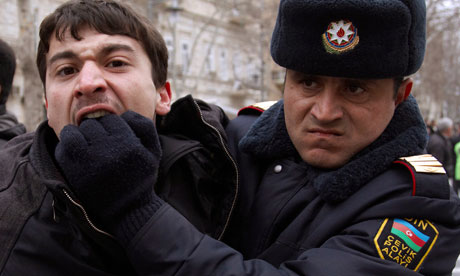
A policeman detains an opposition activist in Baku
A policeman detains an opposition activist in Baku … 'The European Broadcasting Union has to decide how it tackles the issue of Azerbaijan's awful human rights record.'
We are only days away from our annual European dose of kitsch and glamour delivered wonderfully by the Eurovision song contest, coming this year to our living rooms from Baku, Azerbaijan on 26 May.


The warm glow of European togetherness that the show usually generates, at least for an evening, is one of the things the European Broadcasting Union, the association of Europe's national public service broadcasters that puts the contest on stage, loves most about it. The EBU regularly reminds anyone listening that, particularly at such times of economic strain in Europe, it's this music-fest, rather than worthy pan-European political gestures from Brussels or elsewhere, that nudge us toward loving this continent.
This year, the EBU has an extra challenge regarding Eurovision. It has to decide how it tackles the issue of Azerbaijan's awful human rights record – not because it necessarily wants to but because activists in Baku and elsewhere, plus media and some governments in Europe, have forced the issue into the spotlight.
What has come to light? A terrible record on freedom of expression, with six journalists in prison on spurious charges; several dozen opposition political activists also behind bars, according to local monitors; crackdowns on peaceful protests, most recently on Monday in the centre of Baku; tight media controls creating a climate of fear in the country; and physical violence against those saying things the country's authoritarian government, led by President Ilham Aliyev, does not like.
One of the most recent victims was Idrak Abbasov, a respected reporter. Last month he was filming forced evictions and house demolitions by the country's state oil company when the firm's security officials, along with police, viciously beat him unconscious, leaving him hospitalised. Investigations into this and other cases are half-hearted at best.
The EBU's core mandate, of protecting and promoting the basic rights to freedom of expression, might suggest it would use the Eurovision occasion to confront Azerbaijan on its rights record. So far, however, it has very clearly decided not to do so. This is a setback for journalists and others in Azerbaijan standing up for freedom of speech, and a stance that the Baku government can use to legitimise its actions. It's also not great PR for the EBU itself.
For a media alliance that lives off freedom of speech to ignore abuses of that freedom on the doorstep of the show's sparkling seafront venue undercuts the organisation's own credibility.
The EBU has touched gingerly on freedom of expression in Azerbaijan in various statements, and on 2 May held a workshop in Geneva on these issues aimed at promoting "dialogue" between the Azerbaijan authorities, local and international pressure groups, and others.
Sadly, despite EBU pledges of training sessions for journalists in Baku, the organisation largely gave the senior Azerbaijan officials at the workshop a free ride on the government's serious human rights abuses.
If the EBU wants to engage seriously with a country such as Azerbaijan, it has to get off the fence. Such regimes are often brutal and cunning, and they need to face international pressure if they are to stop limiting freedom of expression. In using the EBU's influence, platitudes about more "dialogue", are not enough.
The EBU and its members in 56 countries do have influence, and, on paper, high ethical standards. The body boasts proudly of being "the largest association of national broadcasters in the world", and in 2010 crafted a new international declaration – after a conference in Baku, in fact – "condemn[ing] arrests, harassment and intimidation of journalists" in the EBU region and "call[ing] on governments to investigate all instances of violence against journalists and bring to justice those responsible".
So why so quiet on events on Azerbaijan? On the six journalists in prison on trumped-up charges? On the journalists severely beaten in recent months for doing their jobs? And on the climate of fear that means self-censorship is pervasive?
Human Rights Watch has, over the last nine months, used meetings and correspondence with the EBU to explain the severity of conditions in Azerbaijan and the need to speak out. We have asked the EBU to use its influence to raise publicly the issue of imprisoned and harassed reporters, and to support publicly the efforts by Baku's courageous civil society to organise freedom of speech events in the week before Eurovision.
Such steps would annoy Azerbaijan and, in our view, this is the reason the EBU has refused. It argues that Eurovision is apolitical, and that such issues should be raised on other occasions. But it also admits that, in the show's 57-year history, it has never faced such a wave of international concern about the human rights record of the host country as it has this year.
The EBU still has some time to speak out – and to get ready to monitor events after Eurovision, when the international spotlight will have shifted but local journalists and activists will be at their most vulnerable. Action now by the EBU would be a good signal, also, on how it will handle future Eurovisions. As one EBU official noted – what happens if Belarus wins on 26 May?

Saturday, 19 May 2012

(EN) - EL PASO DEL NOROESTE-

Unmapped Northwest Passage proves perilous for ships that stray

Remote sea lanes in Canada's Northwest Passage poorly mapped yet increasingly popular with cruise lines.(Abridged by José V.)

northwest passage
 
Uncharted ... the Northwest Passage from space. Photograph: AP/NASA
Within the space of a week two ships have been involved in accidents in the Northwest Passage, fuelling debate on the environmental risks associated with shipping north of the Arctic Circle, despite the waters being increasingly ice-free in the summer. Both accidents were blamed on navigation problems, drawing attention to a lack of proper charts for the region.
In late August the cruise ship Clipper Adventurer was heading for Kugluktuk, at the entrance to the passage, when it struck a rock not shown on the map, according to the captain of the ship. The Canadian Coast Guard sent an icebreaker to rescue the 110 passengers, taking them to the ship's next port of call. The condition of the ship – still stuck but said to be "stable" by CCG spokeswoman Chantal Guénette – is being closely watched until it can be refloated.


The MV Nanny, a small Canadian oil tanker, suffered a similar fate on 1 September, running aground on a sandbank in the western part of the passage. Here again a CCG icebreaker soon reached the ship, which was carrying 9m litres of diesel fuel for remote Nunavut communities. An inspection of the vessel confirmed that "no damage has been detected and there are no leaks", said Guénette. The ship's master also blamed the grounding on inaccurate charts.
Louis Fortier, the scientific director of ArcticNet, the main network of Canadian researchers working in the Arctic, is not surprised at the accidents. "Only a tenth of the region is properly mapped," he said.
Dale Nicholson, the head of the Arctic region at Canada's Hydrographic Service, confirmed this figure.
He reckons there is no need to map the whole of the Canadian Arctic for it to be possible to navigate the main channels "but we obviously need more than 10%".
Highly specialised, relatively expensive equipment is required to map the seabed. The Hydrographic Service lacks the financial resources to speed up the process, yet time is running out, says Fortier. "Between 1906 – when the Norwegian explorer Roald Amundsen first negotiated the passage – and 2009, 69 ships took this route. This year, in only seven months, 24 ships have already passed through and most of them are cruise ships. If we want to prevent a rash of accidents, we must make mapping the Arctic a priority," he said.
But it is impossible to control everything. Cruise ships sail too close to the land to give passengers a better view, straying from the properly charted central channel.

This article originally appeared in Le Monde

This article was amended on September 14. It originally read "Highly specialised, relatively expensive equipment is required to map the seabed. The Hydrographic Service lacks the financial resources to speed up the process, yet time is running out, says Nicholson."

Friday, 18 May 2012

(IT) - A VERY LONG LIVE-

Qui Campodimele, Latina
siamo il paese della longevità

Gli abitanti hanno valori particolarmente bassi di colesterolemia totale e Ldl, il "colesterolo cattivo". E sono più protetti da malattie ischemiche legate ad aterosclerosi e diabete. Uno studio dell'università La Sapienza di Roma ha individuato una variante genetica legata a queste condizioni privilegiate

ROMA - Meno di mille abitanti accomunati da un segreto davvero prezioso: ottima salute e una singolare longevità. E' a Campodimele, comune laziale in provincia di Latina, che un gruppo di scienziati dell'università La Sapienza di Roma ha individuato uno dei geni che sarebbe alla base della caratteristica più saliente dei suoi cittadini: una vita lunga e poche malattie.

Il gruppo di ricerca, coordinato da Marcello Arca, ha condotto uno screening accurato sulle caratteristiche genetiche e cliniche degli abitanti del piccolo comune a 150 chilometri da Roma, che presentano valori particolarmente bassi di colesterolemia totale e Ldl.

Dallo studio, pubblicato sulla rivista Journal clinical endocrinology and metabolism, è emersa una mutazione nel gene che sintetizza la proteina chiamata Angptl3. Questa molecola funziona da "freno" all'eliminazione delle lipoproteine che trasportano il colesterolo e i trigliceridi nel sangue. È stato osservato che i soggetti in cui si riscontra la mutazione, oltre a presentare valori bassissimi di colesterolo, godono di una sorta di protezione dalle malattie ischemiche legate all'aterosclerosi e al diabete.

Non è certo la prima volta che si parla di geni della longevità  o di enzimi chiave per il declino delle cellule, di "cocktail" allunga vita . Anche le ultime osservazioni di Arca e colleghi potrebbero avere implicazioni molto importanti per la ricerca farmacologica. "L'esistenza di persone che sono totalmente prive della proteina Angptl3 e che al contempo godono di buona salute - ha dichiarato Arca - ci fa chiaramente ipotizzare lo sviluppo di farmaci diretti contro questa molecola per proteggere i pazienti a rischio di aterosclerosi".

Molti degli abitanti di Campodimele sono ultracentenari. Un'indagine dell'Oms - progetto Monica, Monitoring of cardiovascular diseases, nato all’inizio degli anni Ottanta - aveva già sottolineato questa particolarità, attribuendola allo stile di vita e all'alimentazione degli abitanti che apparivano particolarmente salubri. Ma in seguito, fra gli abitanti di Campodimele già di per sé "virtuosi", è stato individuato un gruppo di persone con valori particolarmente bassi di colesterolemia totale e Ldl, il "colesterolo cattivo " che causa un aumento delle malattie cardiovascolari legate all'aterosclerosi. Lo studio di questi soggetti aveva fin dall'inizio rivelato l'esistenza di una base genetica per tale vantaggio, ma il gene responsabile non era ancora stato scoperto.

Per cercare una risposta al quesito scientifico, il gruppo di ricerca del professor Marcello Arca ha condotto, con il sostegno della municipalità di Campodimele e dell'Asl di Latina, uno screening accurato per definire con precisione il numero di famiglie e i soggetti con bassi livelli di colesterolemia presenti nel paese, e per studiarne le caratteristiche genetiche e cliniche. E ha contribuito ad ampliare una nuova area di ricerca, rivolta all'individuazione di nuove varianti genetiche che possono avere un ruolo protettivo nei confronti delle malattie, soprattutto di quelle legate all'aterosclerosi.
 
(14 maggio 2012) La Repubblica

Thursday, 17 May 2012

(IT) - LA MACCHINA DE ANTICITERA-

ARCHEOLOGIA

Raggi X per il marchingegno
che sapeva spiegare il cosmo

Una nuova tecnologia di esame permette di guardare dentro La "Macchina di Anticitera", il reperto di epoca ellenistica rinvenuto nel 1900 al largo di Cerigotto. Una macchina di precisione in grado di calcolare il movimento degli astri, eclissi e lunazioni. Un dispositivo avanti di mille anni rispetto ad ogni altro ritrovamento, e che anima il dibattito scientifico

UN MISTERO lungo duemila anni sta per ricevere un po' di luce grazie alle tecnologie moderne. L'isola di Anticitera, o meglio le coste, l'hanno custodito per secoli, fino al 1900. L'anno del ritrovamento di quella che viene chiamata la "macchina di Anticitera" da parte di un gruppo di pescatori di spugne, assieme a statue e manufatti risalenti a epoche antiche custodite in un relitto di una nave, affondata al largo di Cerigotto (a Anticitera), isola greda al largo di Creta. Qualcuno la ritiene un'eredità degli studi di Archimede di Siracusa, inventore. La macchina di Anticitera potrebbe essere un progetto laterale del suo famoso planetario.

La macchina di Anticitera. Un complesso innesto di 27 ingranaggi ricoperti da iscrizioni quasi completamente decifrate, la macchina di Anticitera è datata agli anni 100-150 avanti Cristo ed è custodita al museo nazionale ad Atene, dove c'è anche una ricostruzione funzionante.

La macchina è un meccanismo originariamente contenuto in un involucro di legno, dalle misure di 30x15 centimetri che per molto tempo la scienza non è riuscita a catalogare. A metà del secolo scorso grazie ai raggi X, si iniziò a intuirne il funzionamento: la macchina era uno strumento di altissima precisione, studiata nel dettaglio per misurare i movimenti di sole e luna, le eclissi, i loro rapporti di moto e addirittura le lunazioni. E come se non bastasse, la macchina serviva probabilmente anche a definire il calendario delle Olimpiadi.

Ma solo oggi, grazie a una nuova tecnologia di esame radiografico basata su delle sonde a raggi x appositamente inviate ad Atene, i ricercatori hanno potuto vedere davvero cosa c'è nel blocco di roccia che contiene la macchina originale. E i primi risultati vengono definiti "sbalorditivi" per il livello di precisione assoluta con cui il dispositivo può misurare le meccaniche celesti.

Precisione incredibile.
Il mistero della macchina è tutto in questa sua precisione fuori dall'ordinario. E' infatti costruita con materiali comuni per il tempo e le misurazioni sono limitate ai pianeti visibili dalla terra senza ausilio di strumenti particolari. Ma il livello di dettaglio rimane stupefacente: è confermata la capacità del dispositivo di calcolare persino i ritardi nei movimenti lunari, per via dell'orbita ellittica, con un opportuna progettazione e un ingranaggio dedicato. Nelle iscrizioni sulla macchina ci sono i nomi di Venere e Mercurio, ma ci sono studiosi che sostengono che la macchina di Anticitera possa in realtà rivelare informazioni anche su altri pianeti. La macchina viene definita dalla scienza come tecnicamente molto più complessa di ogni altro dispositivo ipotizzabile e rinvenuto per almeno mille anni successivi alla sua datazione. E un tale livello di complessità può significare che chi l'ha costruita fosse aduso a questo tipo di lavoro: non sarebbe quindi un esemplare unico, ma qualcosa che inevitabilmente viene da una storia lunga. La stessa su cui i nuovi studi tenteranno di fare luce.
(12 maggio 2012)

Monday, 7 May 2012

(ES) El español da un jaque en el tablero mundial

El español da un jaque en el tablero mundial

Uno de cada diez cuidadanos en el mundo hablará pronto la lengua de Cervantes, con Estados Unidos a la cabeza. Dominarlo es una ventaja laboral evidente (El País de hace unos días)


En Miami un trabajador bilingüe inglés-español gana, de media, 8.000 dólares más que uno monolingüe. Una cantidad que aumenta si se trata de directivos. Porque el español ha dejado de ser una herencia familiar a preservar para convertirse en una herramienta utilísima de trabajo. Tanto, que en Florida no se pueden cerrar algunos tratos sin este de por medio. El bilingüismo se está instalando ya en Nueva York y pronto manejarse en ambos idiomas será un plus en todo Estados Unidos. No es una exageración, la primera potencia del mundo, que en poco tiempo ha pasado de 36 a 52 millones de hispanohablantes, será en 2050 la que más lo habla. Y dentro de tres generaciones, el 10% de la población mundial podrá comunicarse en español, además de ser oficial en 21 países, la segunda lengua de comunicación internacional y la tercera más utilizada en Internet (136 millones de usuarios en 2008, 8% de la audiencia), según el estudio El español en la Red (Fundación Telefónica, 2010), por detrás del inglés y del chino. Los números no dejan duda, está excelentemente posicionado en el tablero mundial – millones de personas lo estudian y 500 lo hablan (450 como primera)– y debe sacar partido de este dominio. Aunque no es fácil, otros países como el francés, usado en la diplomacia, o el alemán, más comercial, no quieren perder terreno.

CUESTIÓN DE ESTADO
El español es cuestión de Estado y el nuevo Gobierno del Partido Popular lo lleva por bandera. Es un valor económico no cuantificable que aumenta cuanto más se habla. Un botón que da idea de su potencia: 237.000 estudiantes del ELE (Español como Lengua Extranjera) generaron 463 millones de euros en 2007, frente a 130.000 alumnos y 255 millones en 2000. “Una lengua posee grandes propiedades económicas –como destreza o herramienta de comunicación social, como elemento identitario y como soporte creativo– y es, ante todo, un bien que multiplica el potencial comunicativo de una colectividad”, afirman Juan Carlos Jiménez y Aránzazu Narbona en El español en los flujos económicos internacionales (Fundación Telefónica, 2012). “Además, reduce los costes de transacción al igual que lo hace una moneda común y es amortiguadora de la distancia psicológica entre los mercados, ya que compartir una lengua es un factor favorable de inserción empresarial en otros mercados de acogida”.
En el plano económico, con América Latina en pleno desarrollo, el español avanza. “El hispano ya no es un señor que llega a recoger tomates. Ha estudiado, subido socialmente y tiene sus negocios. Por eso desde hace 15 años las familias hablan a los niños en la lengua materna, se han dado cuenta de que, luego, es una ventaja laboral”, recuerda Francisco Moreno Fernández, director académico del Instituto Cervantes. “El 65% de los universitarios estadounidenses estudia español.Son conscientes de su utilidad”, continúa. Incluso la escuela de literatura más prestigiosa de Estados Unidos, integrada en la Universidad de Iowa –por la que han pasado como alumnos o profesores John Irving, Philip Roth o John Cheever– acaba de inaugurar un curso de escritura en español.

No hay que olvidar que su fortaleza mercantil existe también en el campo de las artes. La edición de libros en español en otros países aumenta y hay más demanda que oferta; el pop, con Shakira y los Grammy Latinos a la cabeza, arrasa; el modo de trabajo de las orquestas venezolanas se ha exportado a medio mundo; no cesa la apertura de cadenas de televisión –incluso un canal de noticias iraní o dos nuevas de la Fox, que cuenta también con una web de noticias–; el arte latinoamericano alcanza precios nunca imaginados en las subastas internacionales o el 25% de las obras de artistas nuevos que compra la Tate Modern de Londres provienen del subcontinente. El reto ahora es que esta “moda” perdure en el tiempo y sea una vía para difundir el idioma.
“Si se abrieran 50 Cervantes más en Estados Unidos se llenarían”, asegura Víctor García de la Concha, al frente del instituto, contento de que el español deje de ser “estigmatizado, vinculado a una lengua de inmigrantes que plantea problemas”. Aunque la primera potencia mundial no es el único objetivo. El Cervantes de Pekín, con más de 3.000 alumnos, da idea de la pujanza. “En China está muy valorado hablar otras lenguas. Tiran por el inglés por ser la lengua franca y por la presencia histórica de Reino Unido en Asia. Pero el español tiene su sitio, como el japonés. No solo porque hay muchos chinos viviendo en América Latina, sino porque los contactos bilaterales por comercio son muy intensos”, explica Moreno Fernández.

El 65% de los universitarios de EE UU estudia castellano porque es consciente de su utilidad
“No va a darse la vuelta a la tortilla. El inglés va a seguir siendo el idioma comercial y científico, pero somos conscientes de la proyección del español. Antes de defender su proyecto de fin de grado en inglés, los alumnos tienen que pasar un examen en castellano”, explica Miguel Larrañaga, vicerrector de la IE University. El 65% de los que estudian en inglés son extranjeros, de 70 nacionalidades, y llegan a su campus de Segovia sabiendo la lengua de Shakespeare. “Les ofrecemos español divididos en tres niveles”. Reconoce que su ubicación juega a favor de IE. “Es como pasa con los Erasmus, España es el país que recibe más estudiantes y no es tanto por la calidad de su enseñanza, como por el idioma, el clima y la gente. Nosotros estamos en la lista de las mejores escuelas de negocios del mundo y el castellano es un aliciente más”.
Brasil es desde 2006 un foco de atención primordial. Está rodeado de países hispanoparlantes y para sus negociaciones con sus socios de Mercosur compartir la lengua facilita las cosas. Comenzó ese año a aplicarse la llamada Ley del Español, que obliga a que todos los centros de enseñanzas medias a ofrecerlo. Ya lo practican seis millones, aunque su llegada a las aulas está siendo lenta. Se necesitarían 25.000 profesores y hay tan solo 6.000 y mal pagados. “Es desigual su implantación. En Estados del sur de Brasil, con frontera con Argentina, incluso se estudia más que el inglés. São Paulo, con 5.300 alumnos, es después de Moscú el Cervantes con más gente. El tercero, Manila”, sostiene Moreno Fernández.
España es receptor de muchos estudiantes europeos –.000 este año– y su fuerza por todo el continente es imparable, aunque retrocede en las instituciones. “Treinta millones de europeos se comunican así fuera de España. En Italia hay muchos italianos y uruguayos, en los países nórdicos, chilenos y colombianos…”, explica el director académico del Cervantes. El campo de la investigación es uno de los puntos débiles del español. “Tiene sentido que las publicaciones sean en inglés, pero se puede hacer un trabajo de difusión científica en nuestro idioma”, argumenta. Hoy, según un estudio realizado por la Royal Society británica, el 35% de los artículos publicados en las revistas son de colaboraciones científicas de varios países, por lo que es evidente que la lengua vehicular seguirá siendo en inglés. Lo que ha supuesto un gran palo ha sido la patente única europea, que solo registra en inglés, francés o alemán. Italia y España han recurrido la decisión ante el Tribunal de Justicia de Luxemburgo.
En plena crisis el Cervantes, que ha cumplido 20 años, ha llegado a acuerdos de colaboración con México (primer país en número de parlantes). “Ellos tienen consulados en casi todas las ciudades de Estados Unidos y a su vez ellos pueden usar nuestras sedes por todo el mundo”, explica Moreno Fernández. Y aspiran a ocupar más espacios propios en las universidades extranjeras, un formato más rentable que el de la apertura de centros.
Las palabras de columnista de The New York Times Nicholas D. Kristoff, ganador de dos Pulitzer, resumen muy bien la situación: “El estudio del chino permite acceder a una de las grandes civilizaciones del mundo y abre muchísimas oportunidades. Así que animad a vuestros hijos a que se adentren en el glamoroso mundo del mandarín, pero no olvidéis algo que probablemente será fundamental en su vida: ¡el idioma más importante es el español!”. Ahora el propósito de los gobernantes es hacerlo entender, porque como dice el director de la Real Academia Española, Víctor García de la Concha, “si tardamos 15 años en llegar, el campo estará tomado”.

Thursday, 26 April 2012

(ES) -Aforismi-

(IT) - IL CANE È IL MIGLIORE AMICO DELL'UOMO-


Veglia al cimitero padrone morto
Cagnolino commuove Sardegna


Due mesi fa seguì il corteo funebre dalla chiesa parrocchiale sino al cimitero, dove da allora si reca ogni giorno per un saluto al suo padrone. Il piccolo bastardino color miele che, in paese, a Tonara nel nuorese, chiamano «Senza nome» perchè non si conosce quale gli avesse assegnato il suo padrone ricorda, anche se il rito si ripete solo da alcuni mesi, la costanza della fedeltà del cane Hachiko, protagonista in un film con Richard Gere, che per circa dieci anni aspettò il padrone alla fermata del treno.

La vicenda del «cane fedele» - ha riportato il quotidiano L'Unione Sarda - si è snodata nel tempo dopo che il suo padrone, di 60 anni, è morto improvvisamente per infarto. Alcuni altri cani che teneva con lui sono stati «adottati» da alcuni compaesani ma «Senza nome» ha deciso di vegliare la tomba dell'uomo. Una guardia giurata che controlla il camposanto ha anche notato che la bestiola ha scelto di vivere vicino al camposanto e quando una vicina di casa del pensionato morto, che è anche la madre della guardia giurata, si reca quotidianamente in cimitero per portare un fiore e una preghiera ai suoi morti, dall'erba balza il cagnolino che la segue e assieme entra nel cimitero, raggiungendo la tomba del padrone mentre la donna si dirige verso i suoi parenti defunti, poi dopo un pò il cagnolino riesce e torna nella sua tana, dove i paesani sanno che vive e non gli fanno mancare il cibo.

Tuesday, 24 April 2012

(ES) -LENGUAS MATERNAS-


- En un mundo cada vez más globalizado hablar dos idiomas en lugar de uno parece tener ventajas prácticas evidentes. Si a ello le añadimos que los científicos, desde hace ya algunos años, consideran que el bilingüismo convierte a sus practicantes en personas más inteligentes, con profundos efectos en el cerebro, con mejoras en las habilidades cognitivas no relacionadas con el lenguaje y que incluso llegan a proteger contra la demencia en la vejez nos hallamos ante un hecho notablemente beneficioso.
Así lo asegura Yudhijit Bhattacharjee, de la prestigiosa revista Science, en un artículo publicado este fin de semana en The New York Times. Según sostiene Bhattacharjee, este punto de vista del bilingüismo es diametralmente diferente al que había existido durante el siglo XX. Investigadores, educadores y políticos que consideraron durante mucho tiempo un segundo idioma como una intromisión, desde el punto de vista cognitivo, que dificultaba el desarrollo académico e intelectual de un niño estaban equivocados.
Los científicos han descubierto que la interferencia entre idiomas, lejos de lastrar el rendimiento de un estudiante, lo que supone es una "bendición disfrazada", señala el autor de Science. "Se obliga al cerebro a resolver un conflicto interno, dando a la mente un entrenamiento que fortalece sus músculos cognitivos", añade.

Los bilingües son más hábiles que los monolingües en la solución de ciertos tipos de rompecabezas mentales, como han demostrado diferentes estudios. Asimismo, hablar dos idiomas, según distintas investigaciones, mejora la función ejecutiva del cerebro, el sistema de mando que dirige los procesos de atención que utilizamos para planificar, resolver problemas y realizar otras tareas mentales paralelas.
La diferencia clave entre bilingües y monolingües se centra, según el artículo, en una mayor capacidad para percibir los cambios en el entorno. "Los bilingües tienen que cambiar de idioma a menudo -es posible que hablen con el padre en una lengua y con la madre en otro idioma", afirma Albert Costa, investigador de la Universitat de Pompeu Fabra, en el artículo del diario neoyorquino. "Necesitan estar atentos a los cambios a su alrededor de la misma forma en que estamos atentos a lo que nos rodea cuando conducimos".

Además, la experiencia bilingüe parece influir en el cerebro desde la infancia hasta la vejez. "Y no hay razón para creer que no puede aplicarse también a los que aprenden un segundo idioma más adelante en la vida", concluye el artículo de The New York Times.

La Vanguardia

(ES) - Maneras en la mesa-

En estos últimos días se han hecho comentarios en las redes que van encaminados a destruir más que a crear

Ninguna de las asignaturas que estudiamos en nuestras carreras ni ninguno de los trabajos de traducción que hacemos, nos pueden dar las claves de LA EDUCACIÓN.

Hay que escribir en las redes de forma positiva ya que lo que no podemos hacer es hundir más a las personas que están intentanto salir hacia adelante como pueden.

Como diría un amigo mío:

 —Ao macchè cazz stai a dì Aooo—

Pero yo diría a las personas que no pueden controlar las cosas que escriben en las redes que antes de escribir manden sus comentarios a alguna persona que los pueda editar, corregir, cortar o (y si es necesario) borrar y olvidar.

Buenos días a todos.

J

Sunday, 22 April 2012

(ES) -Español oral-

Me parece muy interesante la relación tan estrecha y a la vez tan autárquica que tenemos algunos españoles con nuestra querida lengua. Quizá sea una mezcla de tradiciones culturales y por consiguiente lingúísticas.


Hoy mismo, sentado en el autobús, he sido testigo de una de las conversaciones más extrañas y a la misma vez más comunes del panorama idiomático que me circunda:

En el autobús muchas veces queremos preguntar al conductor alguna cosa, pero como no queremos molestar, lo hacemos [recordáis: las técnicas de mitigación, http://www.leeds.ac.uk/linguistics/WPL/WP2000/Davies.pdf] de una forma sutíl. Hablamos con voz baja (para que no se entere mucha gente), con un tono que nos recuerda más a caperuita roja que a una persona real etc.

Bueno, pues, esta tarde además de todas estas técnicas de mitigación internacionales me he dado cuenta de que en el sur de España tenemos una más que es: no terminar las frases.

Por lo que he podido averiguar esta técnica se centra en no terminar las frases ya que:

1) La persona que debe responder interrumpe antes de que la persona que pregunta haya terminado.
2) La persona que habla no pretende (en lenguaje coloquial son muy normales las interrupciones) terminar la pregunta porque espera ser interrumpida.
3) La persona que pregunta, al no terminar la frase, da el poder en la conversación mayor a la persona que tiene que responder (mitiga la pregunta) ya que esta puede interpretar con más libertad la pregunta y responde más o menos a lo que quiere.
4) Todas las anteriores llevan a la implicatura de que no queremos ser irrespetuosos y que estaríamos muy agradecidos de que nos hiciera el favor.

La conversación ha sido la siguiente:

Una mujer se adelanta, mientras el autobús de línea está parado en una de las paradas previstas, desde la parte de atrás hasta cerca del conductor, y dice:

— mmmmmm...—dice la señora— podría usted...es que me viene mejor un poco más...si no le importa...sí...detrás de...bueno, más adelante...

—Bueno, yo nunca...es que normalmente...bueno, pero baje rápidoresponde el conductor .

Mi alegría y mi sorpresa es que estas dos personas se comprendieran exactamente y además se creara la implicatura de la petición educada.

Llegados a esta punto podríamos decir, bueno, pero, ¿no sería más económico, rápido, claro y más correcto decir directamente "por favor" en un tono normal y no tener que pasar por la agonía de la voz baja, la cara de corderico degollao entre otras formas de concesión linguística?

Bueno, pues aquí quería llegar yo. Los españoles somos un pueblo que, en su mayor parte nos avergonzamos de ser educados y de hablar con propiedad en situaciones públicas [para no imponernos, supongo]. Tenemos grabado [quizá algún compañero sociólogo pudiera estudiar convenientemente desde un punto de vista histórico ésto] en nuestra consciencia colectiva [en el registro coloquial de la lengua, esto es] la conveniencia de no disturbar a la persona que tiene en práctica la situación bajo control con un lenguaje correcto y debemos usar entonces otras medidas de mitigación que puedan justificar la necesidad de nuestra petición y la imposibilidad de evitarla, aunque sea con los ojos llorosos.

En estas ocasiones las máximas de cantidad, calidad, relación y manera de Grice, cobran un cierto valor añadido.

José


Thursday, 19 April 2012

(IT) -Cinema Paradiso-

LA LENGUA Y LA CULTURA


El cine, es una de las piezas culturales que más me interesan de la cultura italiana. Como cualquier italianista podrá confirmar el cine de este país y su capacidad de transmitir la cultura popular desborda cualquier intento de emular la misma hazaña de otros países transalpinos. 

Después de ver un puñado de películas italianas de Alberto Sordi o de Vittorio Gassman, se confirma ante los ojos de cualquier persona a la que me guste el cine que si Italia no es exactamente así, le falta poco.
Me interesa, sin embargo, sobremanera saber si el italiano que se usa en las películas que se presentan como películas "populares" es el mismo que se usa en la realidad. En estos últimos meses, y después de interminables charlas sonbre el tema con PABLO ZAMORA (UMU) perece que la conclusión académica es que extrayendo un corpus de unidades fraseológicas podemos estudiar la fijación, el registro y otros parámetros el su uso.

Ahora, como ya sabemos, el lenguaje del cine se llama oralidad prefabricada. ¿No podría ser que las UFs del cine popular en Italia se usen para poner encima de los personajes una tarjeta que nos explique a que nivel diastrático pertenecen?


Yo, personalmente no me creo que las personas en italia se comporten de una determinada manera o que se pasen las horas muertas diciendo:
  •   Ma lo vuoi allora il caffè? [dislocazione a destra]
  •   È meglio che tu vai a fare la spessa. [Neutralizza il congiuntivo]
  •  
Lógicamente la evidencia está ahí y el italiano es una lengua en plena evolución debido a factores históricos pero, ¿podemos hacer que desaparezcan dos registros y quedarnos solo con un único registro medio-bajo de habla popular?
El próximo 3 de mayo a las 12:00 CARMEN MELLADO estará en la UMU para hablar de Fraseología y otras estulteces de la lengua. así que no podré perdérmelo. Veremos a ver que se dice al respecto.